


Small business search engine marketing is essential for tech-savvy small business owners striving to boost their online presence in today’s competitive marketplace. By leveraging digital marketing, businesses can:
- Increase online visibility through targeted ad campaigns
- Drive more traffic and conversions via strategic keywords
- Achieve competitive edge even with limited marketing budgets
An effective online strategy is not just beneficial; it’s necessary to stand out amidst the sea of competitors. Search Engine Marketing (SEM) provides small businesses with the tools needed to lift their digital marketing efforts, reaching potential customers precisely when they’re searching for relevant products or services.
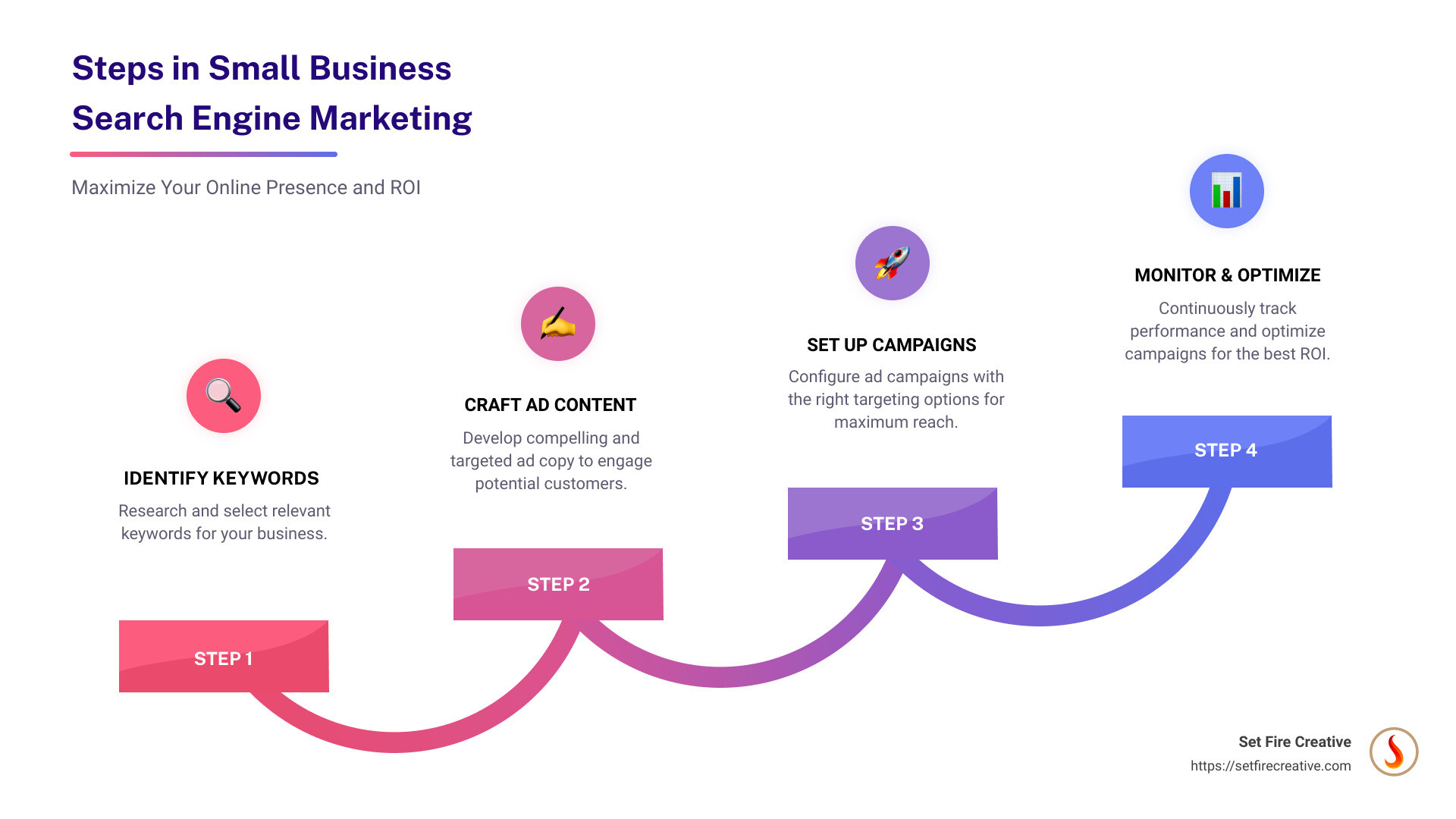
Understanding Small Business Search Engine Marketing
Search Engine Marketing (SEM) is a powerful tool for small businesses aiming to shine online. It involves using paid strategies to increase visibility on search engines like Google. Let’s break down the basics of SEM and how it can help you.
SEM Basics
At its core, SEM is about making your business visible to people searching for your products or services. Think of it as a digital billboard that appears right when someone needs what you offer. Unlike traditional advertising, SEM is targeted and measurable. You can see exactly how your ads are performing and adjust them to get better results.
Paid Search Marketing
Paid search marketing is a big part of SEM. This is where you pay for your ads to show up in search results. When someone types in a keyword related to your business, your ad might appear at the top of the page. The beauty of this is that you’re reaching people who are already interested in what you offer.
A great example of paid search marketing is Google Ads. It allows you to create ads and target them based on keywords, location, and even the time of day. This precision ensures that your marketing dollars are spent effectively.
Keyword Bidding
Keyword bidding is like an auction. You bid on keywords relevant to your business, and the highest bidder gets the best ad placement. But it’s not just about throwing money at the problem. It’s about smart bidding.
Using tools like Google Ads Keyword Planner can help you find the right keywords to bid on. You want keywords that are popular but not too competitive, so you get the best bang for your buck.

Stacy Poliseo, SVP of digital marketing at Regions Bank, notes that the landscape of keyword bidding has evolved. “Best practices are different from what they were in the past,” she says. Understanding what motivates search and focusing on longer, specific keywords can lead to higher conversion rates.
By mastering these SEM basics, small businesses can effectively compete with larger companies, reaching the right audience at the right time. In the next section, we’ll explore the key components that make an SEM strategy successful, including ad copy and landing pages.
Key Components of a Successful SEM Strategy
Creating a successful small business search engine marketing strategy involves several key components. Let’s explore each one and see how they contribute to your business growth.
Keywords
Keywords are the foundation of any SEM strategy. They connect your ads with the search queries of potential customers. Choosing the right keywords is crucial. You want words that are relevant to your business and align with what your customers are searching for.
There are three main types of keywords to consider:
- Broad Match: These include variations of a keyword. For example, if you run a bakery, “fresh bread” might include “artisan bread” or “sourdough bread.”
- Phrase Match: These keywords are more specific. They include the exact phrase with additional words before or after. For instance, “best bakery in Orem” or “affordable bakery services.”
- Exact Match: These are the most specific. They target the exact keyword and slight variations. For example, “bakery Orem” or “bakeries in Orem.”
Using tools like Google Ads Keyword Planner can help identify the best keywords for your business.
Ad Copy
Once you have your keywords, the next step is crafting compelling ad copy. Your ad copy should grab attention and entice users to click. It’s not just about being catchy; it’s about being relevant and clear.
Consider these tips for effective ad copy:
- Include Keywords: Make sure your main keyword appears in the headline. This helps users see the relevance of your ad to their search.
- Highlight Benefits: Focus on what sets your business apart. Are you offering a discount? Do you have a unique product?
- Include a Call to Action (CTA): Encourage users to take the next step, whether it’s “Shop Now,” “Learn More,” or “Contact Us.”
Landing Page
The landing page is where users end up after clicking your ad. It should match the promise of your ad and provide a seamless experience. A well-designed landing page can significantly increase conversion rates.
Here’s what makes a great landing page:
- Relevance: Ensure the content matches the ad. If your ad is about a sale, the landing page should feature that sale prominently.
- Simplicity: Keep it simple and focused. Avoid clutter and make sure the desired action is clear.
- User Experience: Make navigation easy and ensure the page loads quickly. A slow or confusing page can turn potential customers away.
User Experience
A positive user experience is crucial for keeping visitors on your site and encouraging them to convert. This includes everything from site speed to ease of navigation.
Key elements of user experience:
- Mobile-Friendliness: Ensure your site looks great on all devices. With more people browsing on phones, this is more important than ever.
- Fast Loading Times: A slow site can frustrate users. Aim for a load time of under three seconds.
- Clear Navigation: Make it easy for users to find what they’re looking for. Use clear menus and links.
Device Targeting and Bid Management
Device targeting allows you to target ads to specific devices, such as mobile phones or desktops. This is vital as user behavior can vary by device.
Bid management involves adjusting your bids based on performance. Smart bidding strategies can help maximize your return on investment (ROI).
Consider these strategies:
- Device Bids: Adjust bids for devices that perform better. If most conversions come from mobile, increase bids for mobile users.
- Time-Based Bids: Modify bids based on the time of day or week. If evenings are peak times, increase bids during those hours.
Regularly reviewing and adjusting your bids can lead to more efficient spending and better results.
By focusing on these key components, small businesses can create an SEM strategy that not only improves visibility but also drives growth. Next, we’ll look into how to choose the right SEM keywords for your business.
Choosing the Right SEM Keywords for Your Business
Selecting the right SEM keywords is like choosing the best bait for fishing — it determines what you catch. Let’s explore how to do this effectively for your small business.
Keyword Research
Start with keyword research. This is the foundation of any successful SEM campaign. Use tools like Google Ads Keyword Planner to find keywords that are relevant to your business. These tools can show you how often people search for certain terms and how competitive they are.
When researching, focus on:
- Relevance: Choose keywords that directly relate to your products or services.
- Volume: Look for keywords that have a decent search volume. This means people are actively searching for them.
- Competition: Balance between high and low competition keywords. While high-competition keywords can bring more traffic, they might be costly. Low-competition keywords can be more economical but might not bring as much traffic.
Keyword Categories
Keywords can be grouped into different categories. Understanding these can help tailor your strategy:
- Broad Match: These include variations of a word or phrase. For example, if you run a bakery, broad match keywords might include “baked goods” or “fresh pastries.”
- Phrase Match: These are more specific. They include the exact phrase with additional words before or after. For instance, “best bakery in Orem” or “affordable bakery services.”
- Exact Match: These are the most specific. They target the exact keyword and slight variations. For example, “bakery Orem” or “bakeries in Orem.”
Search Intent
Understanding search intent is crucial. This means knowing what users are looking for when they type a keyword. Are they looking to buy, learn, or compare?
For instance, someone searching for “buy cupcakes Orem” likely wants to make a purchase. Tailor your ads and landing pages to match this intent. Providing relevant content increases the chances of conversion.
Negative Keywords
Don’t forget about negative keywords. These are terms you exclude from your campaigns because they don’t align with your goals.
For example, if you sell baked goods but not recipes, you might want to exclude “recipes” as a keyword. This ensures your ads don’t show up for searches unlikely to convert, saving you money.
By focusing on these aspects of keyword selection, you can create a targeted and cost-effective SEM strategy. Next, we’ll explore how to optimize your SEM campaigns for better performance.
Optimizing Your SEM Campaigns
Once you’ve nailed down your keywords, it’s time to optimize your small business search engine marketing campaigns for maximum impact. This involves understanding the ad auction, boosting your quality score, structuring your account wisely, and keeping a close eye on performance.
Ad Auction
Every time someone searches for a keyword, an ad auction takes place. This is how Google decides which ads to show and in what order. The auction considers your bid amount and quality score.
-
Bid Amount: This is how much you’re willing to pay for a click. Higher bids can increase your chances of winning the auction, but it’s not the only factor.
-
Quality Score: Google assigns a quality score to each ad, based on its relevance and the landing page experience. A higher score can lower your cost-per-click and improve your ad position.
Quality Score
Your quality score is crucial for a successful SEM campaign. It’s like a report card for your ads, with grades ranging from 1 to 10. The better your score, the less you pay per click.
To improve your quality score, focus on:
-
Relevance: Ensure your ad copy matches the keywords and search intent. This makes your ad more appealing to users.
-
Landing Page Experience: Make sure your landing page is relevant, easy to steer, and loads quickly. A good user experience can boost your score.
-
Click-Through Rate (CTR): A higher CTR indicates that users find your ad helpful. Use compelling ad copy and calls to action to increase CTR.
Account Structure
A well-organized account structure is like a tidy closet — everything is easy to find and manage. This can improve your campaign’s performance and make it easier to track results.
-
Ad Groups: Group similar keywords and ads together. For example, if you own a bakery, you might have separate ad groups for cupcakes, bread, and cookies.
-
Campaigns: Organize campaigns by theme or goal. For instance, you could have one campaign for seasonal promotions and another for everyday products.
-
Ad Rotation: Test different ads to see which perform best. Rotate them evenly and use performance data to refine your strategy.
Performance Tracking
Tracking performance is vital for optimizing your SEM campaigns. It’s like having a GPS for your marketing efforts, showing you what’s working and what needs adjustment.
-
Key Metrics: Monitor metrics like CTR, conversion rate, and cost-per-click. These indicators show how well your campaign is performing.
-
A/B Testing: Regularly test different ad copies, keywords, and landing pages. Use the results to make data-driven decisions.
-
Adjustments: Be ready to tweak your strategy based on performance data. This could mean changing bids, pausing underperforming ads, or refining targeting.
By focusing on these components, you can fine-tune your SEM campaigns, improve efficiency, and get better results. Now, let’s dive into advanced SEM techniques that can give your small business an edge.
Advanced SEM Techniques for Small Businesses
In small business search engine marketing, staying ahead of the competition means embracing advanced techniques. Let’s explore some strategies that can lift your SEM efforts.
Geo-Targeting
Geo-targeting allows you to focus your ads on specific locations, ensuring that your marketing dollars are spent where they’ll make the most impact.
-
Local Relevance: By targeting specific areas, you can tailor your ads to address local needs and preferences. This is especially useful for businesses with physical locations or those offering services in specific regions.
-
Cost Efficiency: Instead of spreading your budget thin across a wide area, geo-targeting helps you concentrate on regions with the highest potential for conversions.
Using location extensions in your ads can further improve local relevance, showing potential customers that you’re nearby and ready to serve them.
Long-Tail Keywords
Long-tail keywords are specific phrases that may have lower search volumes but often lead to higher conversion rates.
-
Higher Conversion Rates: Users searching with long-tail keywords tend to be closer to making a purchase decision. For example, someone searching for “best vegan bakery in Orem UT” is likely ready to buy compared to a generic search like “bakery.”
-
Lower Competition: These keywords usually face less competition, making it easier and cheaper to rank for them.
Focusing on long-tail keywords can help small businesses capture a niche audience and improve ROI.
Voice Search
With the rise of smart speakers and voice-activated assistants, optimizing for voice search is becoming increasingly important.
-
Conversational Phrases: Voice searches are typically more conversational and longer than text-based searches. Think about how people naturally speak and structure your keywords accordingly.
-
Question-Based Queries: Many voice searches are in the form of questions, like “Where is the nearest coffee shop?” Tailoring your content to answer these questions can improve your visibility in voice search results.
By adapting your strategy to include voice search, you can reach a growing segment of users who prefer hands-free searching.
Localized Content
Creating content that resonates with your local audience is key to building a strong connection with them.
-
Community Engagement: Share content that reflects local events, news, or interests. This not only boosts local SEO but also fosters a sense of community and loyalty.
-
Localized Keywords: Incorporate location-specific keywords into your content to improve your chances of appearing in local search results. For example, use terms like “Orem UT bakery specials” instead of just “bakery specials.”
Localized content helps your business stand out in local searches, attracting customers who are nearby and ready to engage.
By leveraging these advanced SEM techniques, your small business can achieve greater online visibility and attract more local customers. Now, let’s answer some frequently asked questions about small business search engine marketing.
Frequently Asked Questions about Small Business Search Engine Marketing
What is the difference between SEM and SEO?
Search Engine Marketing (SEM) and Search Engine Optimization (SEO) are both strategies to boost your business’s visibility online, but they differ in approach.
-
SEM involves paid search tactics to place your ads at the top of search engine results pages (SERPs). This means you pay for each click (PPC) your ad receives, giving you an immediate presence in search results.
-
SEO, on the other hand, focuses on organic search. It involves optimizing your website’s content, structure, and links to naturally rank higher in search results over time. SEO is a long-term investment that doesn’t require direct payment for clicks but demands consistent effort and optimization.

How can small businesses benefit from SEM?
Small businesses can greatly benefit from SEM in several ways:
-
Customer Leads: SEM can drive targeted traffic to your site, increasing the chances of converting visitors into customers. With precise targeting, your ads reach users actively searching for your products or services.
-
Online Visibility: By appearing at the top of search results, SEM improves your brand’s visibility. This is crucial for small businesses looking to establish a presence in a competitive market.
-
Flexibility and Control: With SEM, you have control over your budget and can adjust your campaigns in real-time based on performance. This flexibility allows small businesses to optimize their strategies for the best results.
What are the best SEM tools for small businesses?
To effectively manage SEM campaigns, small businesses can leverage various tools:
-
Google Ads: This is the most popular platform for creating and managing paid search campaigns. It allows you to set budgets, choose keywords, and track performance.
-
Keyword Planner: A feature within Google Ads, the Keyword Planner helps identify relevant keywords for your business. It provides insights into keyword search volumes and competition, aiding in strategic decision-making.
These tools are essential for small businesses to plan, execute, and refine their small business search engine marketing strategies, ensuring they reach the right audience at the right time.
By understanding these key aspects, small businesses can effectively use SEM to improve their online presence and attract more customers. Let’s now explore some common concerns and questions small businesses have about SEM.
Conclusion
Small business search engine marketing is not just an option—it’s a necessity. At Set Fire Creative, we understand the power of a well-crafted SEM strategy. Our mission is to transform your business story into compelling digital content that captivates and converts.
Digital content is the cornerstone of modern marketing. It’s how your brand communicates with the world, and it’s crucial to get it right. With our expertise, we ensure that your digital narrative not only reaches your target audience but resonates with them. This connection is what drives engagement and, ultimately, business growth.
Business growth is the ultimate goal of any marketing effort. Through strategic SEM, we help your business climb the ranks of search engine results, increasing visibility and attracting more potential customers. Our custom approach ensures that every dollar spent on SEM delivers value, bringing you closer to your growth objectives.
Partner with us at Set Fire Creative. Let’s lift your small business to the top, where it deserves to be. Together, we’ll harness the power of digital marketing to fuel your business’s success.

McCain is the founder and VP of Client Services at Set Fire Creative. When he isn’t busy helping his clients grow their business through digital marketing, you will most likely find him with his nose in a Stephen King book, eating spicy buffalo wings, hanging out with his wife and Blue Heeler Ozzy, or listening to Guns N’ Roses—sometimes all at the same time.
